Showing posts with label New York. Show all posts

Monday, March 11, 2013

The Wanderers by Richard Price

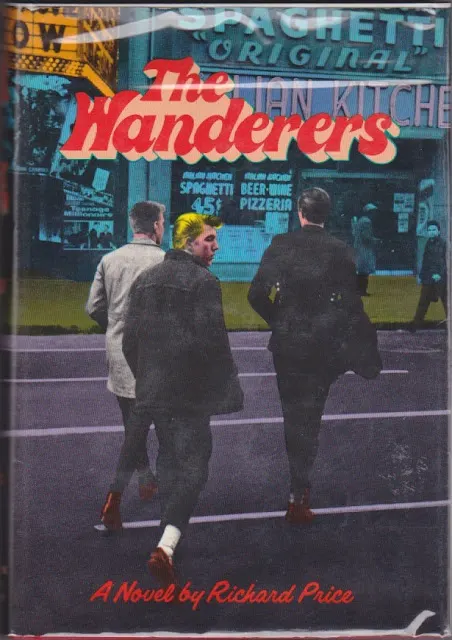
First edition of The Wanderers published by Houghton Mifflin in 1974
The Wanderers is Richard Price's first novel and one of his best; praised by everyone from William S. Burroughs to John Fowles particularly for it's realistic dialogue and accurate street vernacular, the story revolves around a group of teen gangs in the 1960's Bronx, New York City. One of the central characters is Richie Gennaro, leader of the Wanderers gang, and the story mainly follows his development, among other gang members, as he is forced to grow up and confront the real world in various ways. The Wanderers features an incredibly colorful cast of characters from around their neighborhood and rival gangs they must deal with like the Pips and the Baldies. This first edition has amazing cover art done by veteran jacket artists Batten & Kreloff, but The Wanderers is well worth the read no matter what edition you come across.

Monday, February 18, 2013

V. by Thomas Pynchon

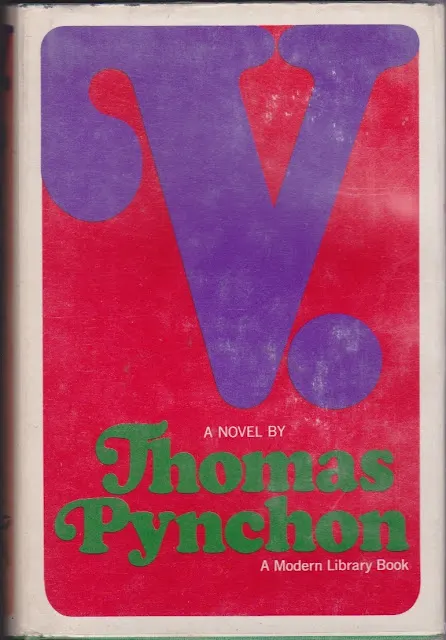
First Modern Library edition of V. by Thomas Pynchon from 1966
Thomas Pynchon's first novel, originally published in 1963, is a book that needs little introduction. Pynchon and his work, although widely known, all fall under the categories of cool, weird, and rare, and this Modern Library edition of his first novel is particularly scarce. V. is probably the most concentrated embodiment of what would later be known as Pynchon's hallmark weird, and technically daring style. It is less complex than Gravity's Rainbow, not to mention shorter, but in my view V. is just as good and definitely easier to get through. One plot line follows sailor Benny Profane and hangers-on from the Whole Sick Crew, and the other follows Herb Stencil and his family's history with a mysterious woman known as "V." The intricately laid plots eventually converge on each other as the novel progresses, forming a V-shape itself as Profane and Stencil cross paths and band together at the end to find V. Pynchon's first novel also features an amazingly diverse cast of characters, many of whom appear more prominently in later works like Pig Bodine and Kurt Mondaugen, and different segments set in various parts of history from all around the world. V. marked the beginning of a new kind of voice and style of writing that had never existed before, and is incredibly important for that reason alone, not to mention being the front bookend of Pynchon's oeuvre. This first Modern Library edition features great, simplistic 1960's cover art by S. Neil Fujita.

Tuesday, February 5, 2013

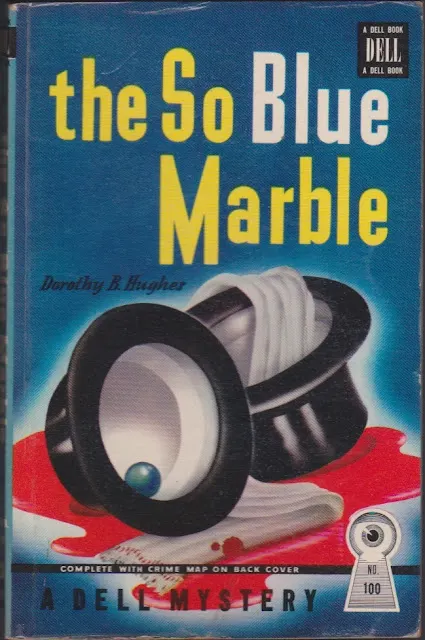
The So Blue Marble by Dorothy B. Hughes

Dell Mystery edition of The So Blue Marble from 1946
The So Blue Marble is Dorothy B. Hughes' first novel and foray into mysteries, a genre to which she would go on to dedicate the majority of her career. Hughes was one of the more talented and recognized female mystery writers of the 20th century, and The So Blue Marble marks the beginning of her fun-to-read stories of suspense from 1940. This Inspector Tobin mystery follows former movie star Griselda Satterlee as she comes to glittery, mid-century New York City to relax and stay in her ex-husband's apartment while he's away. Griselda quickly finds herself in the center of a plot to regain an ancient blue marble, which feature the identical, sinister Montefierrow twins, who are convinced that Griselda has the eponymous marble. The reader learns that the marble apparently holds a secret, ancient formula which can be used to master gravity. As bodies pile up around the city, Griselda must work with Inspector Tobin to get the twins off her back and end the string of murders. While the driving force of the plot is a little farfetched, Hughes' book is incredibly engaging to read and one will quickly overlook how fantastical it is. Featuring great cover art of the twins' matching top hats in a pool of blood (by an unknown illustrator), this Dell Mystery edition is a wonderful artifact of the genre.

Back cover featuring the convenient Crime Map, which depicts the relevant areas where a murder took place

Wednesday, January 2, 2013

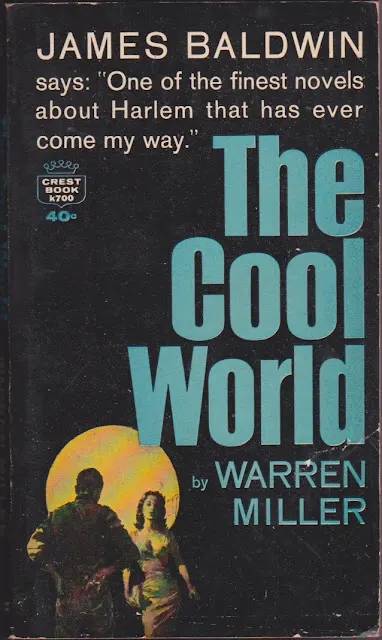
The Cool World by Warren Miller

Second edition paperback copy of The Cool World from 1964 
First published in 1959, The Cool World is the most famous of Warren Miller's work (all of which is relatively unknown) about a youth gang called the "Crocadiles" in 1950's Harlem, New York City. Narrated in the first person by the protagonist and Crocadile member Duke, The Cool World recounts the story of Duke and his gang's adventures and travails as they deal with street life in the ghetto and a rival gang called the Wolves. Drug dealing, fights, prostitution, guns, and gambling are rampant throughout this engaging, slim novel that rarely has a dull moment. Written entirely in African-American street vernacular of the time, Miller—a caucasian academic—accomplished a great, and mostly unnoticed, linguistic and narrative feat with this novel. The Cool World has been out of print since the late 1960's, but paperback copies aren't too difficult to come by—the featured copy above was published by Crest Books, a subsidiary of Little, Brown. Slightly better known than Miller's novel is a film adaptation by Shirley Clarke of the same name, also from 1964, which happens to be playing at Film Forum in New York on January 13th and 14th. I strongly suggest seeing it if you live in the five boroughs, as well as locating a copy of this forgotten novel.

Friday, November 23, 2012

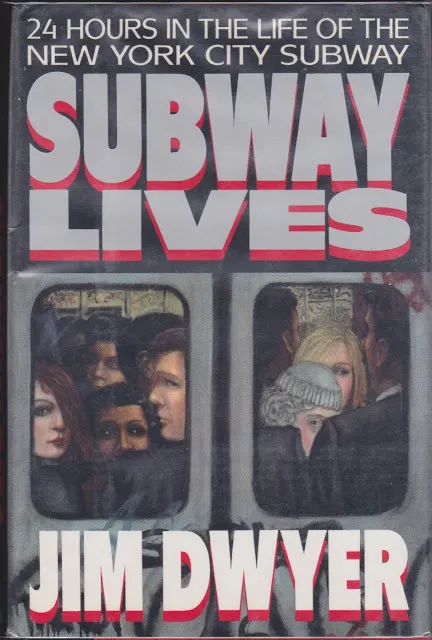
Subway Lives by Jim Dwyer

First edition of Subway Lives published by Crown Publishers in 1991
Journalist Jim Dwyer's Subway Lives is an amazing series of non-fiction vignettes that revolve around the New York City subway system over a 24 hour span. Dwyer's account follows higher-ups in the Transit Authority, especially David Gunn, who is famous (and infamous) for ending the graffiti pandemic on the subway, a pregnant woman who gives birth on the subway, petty thieves, a mentally challenged teen, traffic control rooms, subway police, a conductor with a strange penchant for singing, and a few of New York's most famous graffiti writers at the time, Reas, JA, Soni, and Slick. Interspersed with a bevy of historical information about the subway system and statistical figures, Dwyer's book is a treasure trove of late 1980's/early 1990's New York City. While this book will obviously appeal more to New York natives or people who have lived here, it is still an interesting social study from a particularly transformative time in the history of the city and it's world renowned subway system. Dwyer himself is a New York City native and covered the subway beat for New York Newsday in the late 1980's before reporting for the Daily News and eventually the New York Times. With excellent book design by June Bennett-Tantillo, Subway Lives remains an artifact of a bygone time in New York City.

Friday, September 21, 2012

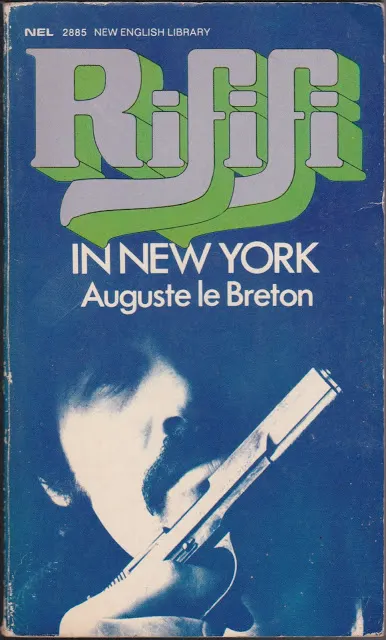
Rififi in New York by Auguste le Breton

Paperback edition from 1970 published by the New English Library
First published in France in 1967, Rififi in New York is part of Auguste le Breton's series of Rififi crime novels featuring an assortment of criminals and cops that take place in various cities around the globe. Le Breton himself began his career as a small-time crook, calling himself "a man of the underworld," and later became a hero in the Resistance during the Nazi occupation of France. After the war le Breton turned his focus to writing, and became a prolific writer of novels that typically revolve around criminals and their schemes or heists. Le Breton was a big proponent of slang in his novels, and coined the word "Rififi," which he legally owned, and is slang for a sort of conflict or melee. Rififi in New York is one of the better Rififi novels (next to the original Rififi) and features a crew of independent gangsters as they try and steal $20 million in jewels from the Diamond Exchange, all the while trying to stave off the mafia and the police. Le Breton came to New York to write this novel, and it features a greatly detailed landscape of 1960's New York City. With great cover art and typography by an unknown designer, as well as an odd Charles Bronson look-alike, le Breton's novels and Rififi in New York definitely deserve checking out.

Wednesday, August 22, 2012

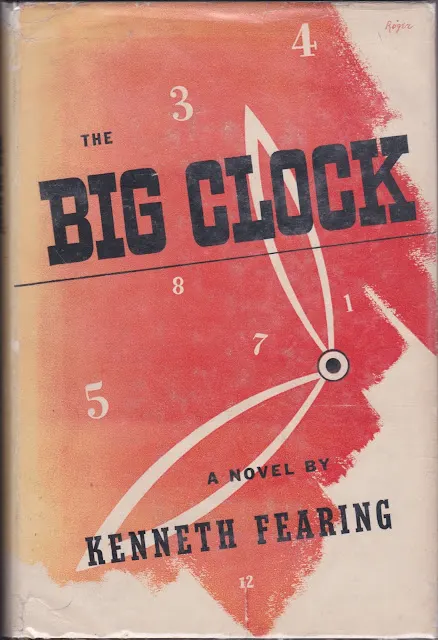
The Big Clock by Kenneth Fearing

First edition of The Big Clock published by Harcourt Brace in 1946
This thriller by Kenneth Fearing is my favorite of his books; The Big Clock tells the enthralling story of George Stroud, family man and news executive, who is the last person to see his mistress Pauline Delos alive. The problem is that he knows his boss, powerful news magnate Earl Janoth, is the murderer. Janoth knows someone was in the shadows the night she was killed but he can't figure out who it was, and uses the vast media resources of Janoth Enterprises to track down this supposed murderer, most specifically his publication "Crimeways," which George Stroud heads up. Tasked with having to track himself down, Stroud must race against time to prove his own innocence and Janoth's guilt. The Big Clock is stylistically unique, especially for a crime novel from 1946, in that most of the chapters are told from a different character's point of view while juggling the plot. It is also poetically eerie in certain ways like how each member of George Stroud's family has a variation of the name George (i.e. Georgette and Georgia), and all of Janoth's publications have the same kind of title ("Futureways," "Newsways," etc.). Fearing's novel feels like it exists within a noir-ish microcosm of old New York and is tremendously fun to read. This first edition features great cover art attributed only to someone who signed "Roger" on the top right corner of the front cover.

Thursday, August 16, 2012

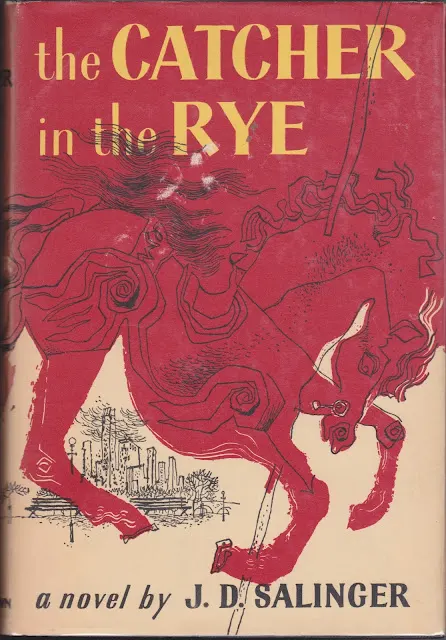
The Catcher in the Rye by J.D. Salinger

Book of the Month Club edition published by Little, Brown in 1951
This is a book that doesn't really need an introduction or synopsis; it also isn't predominantly weird or rare (except for the edition), and falls mostly into the category of cool. This copy of The Catcher in the Rye was published later in 1951, the same year as its initial publication, although was part of the third or fourth printing for the Little, Brown Book of the Month Club (BOMC). The main aesthetic difference between later printings and the first edition is that the first run had Salinger's photo on the back cover and he demanded that it be taken off for future editions. A secondary printing by Grosset & Dunlap around the same time had advertisements on the back cover, which he also demanded be taken off, and so all subsequent printings just had blank white on the back (which I would have scanned except it is literally just an empty white space). The cover of Salinger's only full-length novel features amazing, and now iconic, jacket design by Michael Mitchell (sometimes credited as E. Michael Mitchell) depicting a carousel horse in Central Park and part of the city. After its publication, Salinger became friends with Mitchell and corresponded for the better part of four decades. On the back flap Salinger is quoted as saying, "I've been writing since I was fifteen or so. My short stories have appeared in a number of magazines over the last ten years, mostly—and most happily—in The New Yorker. I worked on The Catcher in the Rye, on and off, for ten years." I value this copy immensely, despite the small physical imperfections on the cover, and will have to do because first printings go for many thousands of dollars.

Monday, May 28, 2012

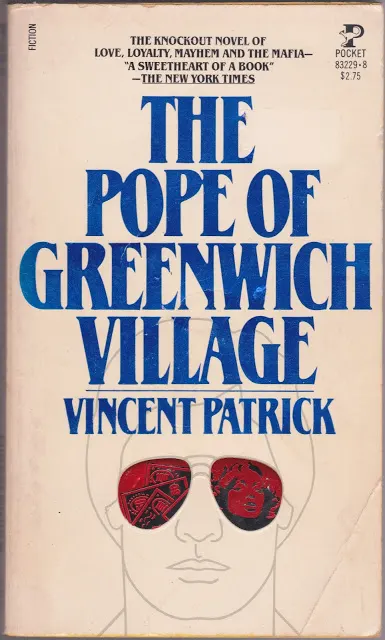
The Pope of Greenwich Village by Vincent Patrick

Paperback edition published by Pocket Books in 1980
Vincent Patrick's first novel, originally published in 1979, chronicles the lives of some New York low-lives and the mob at the end of the 1970's. Focused largely in downtown Manhattan, Patrick's novel was the inspiration for the film starring Mickey Rourke and Eric Roberts, which Patrick helped write. While many more people are aware of the film version, in my opinion the book is much better and slightly different—a main change being that Barney, the safecracker, has a retarded son who was left out of the movie. The language and dialogue Patrick uses are excellent and authentic; the first of his three books definitely deserves reading, whether you've seen the movie or not.

Friday, May 18, 2012

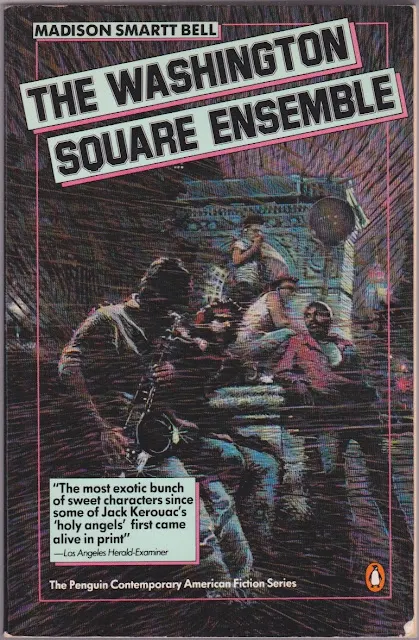
Washington Square Ensemble by Madison Smartt Bell

Penguin paperback copy of Washington Square Ensemble from 1984
Washington Square Ensemble is Madison Smartt Bell's first novel and my favorite. He's more famous for his later works but I like this book best—it chronicles the streets of 1980's downtown New York City, especially the eponymous park, and centers around the struggles of five Washington Square regulars. With characters named Johnny B. Goode, Yusuf Ali, Holy Mother, Santa Barbara, and Porco Miserio, this book is nothing short of interesting. Largely centered around the using and selling of drugs at the height of crime-addled New York, Bell's novel is now an engaging time capsule from a bygone era. The cover features a nice 1980's illustration by David Berkner.

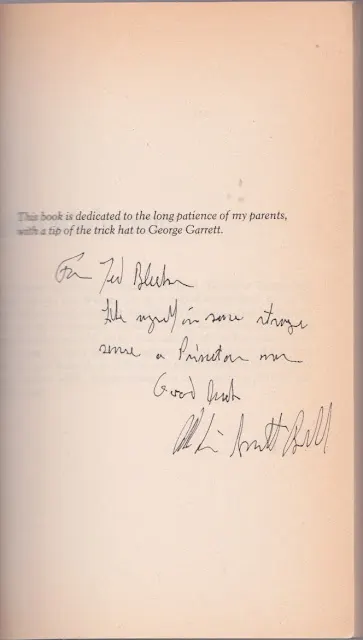
A practically illegible inscription by Madison Smartt Bell